
May 19, 2026
April 2026 Sustainability Grant Awarded to EcoSet

EcoSet
Woman Entrepreneur:
Kris Barberg
Her Website:
https://ecoset.la
We’re excited to announce the April $10,000 Business-Category: Sustainability Grant recipient. Congratulations to Kris Barberg, founder of EcoSet.
Recently, WomensNet Advisory Board member Jama Hernandez sat down with Kris for an exclusive interview. You can listen to their conversation and view the transcript below.
Video Transcript
Jama: Hi everyone. My name is Jama with WomensNet, and we are excited to introduce to you our 2026 April grant recipients. So, as an introduction, we have with us Kris with EcoSet. She is our business category grant winner which was sustainability for the month of April. Thank you so much for being here today. We really appreciate it. And we’re looking forward to learning more about your business and to know what makes your business unique in your field. Please tell us about your business and who or what inspired your business.
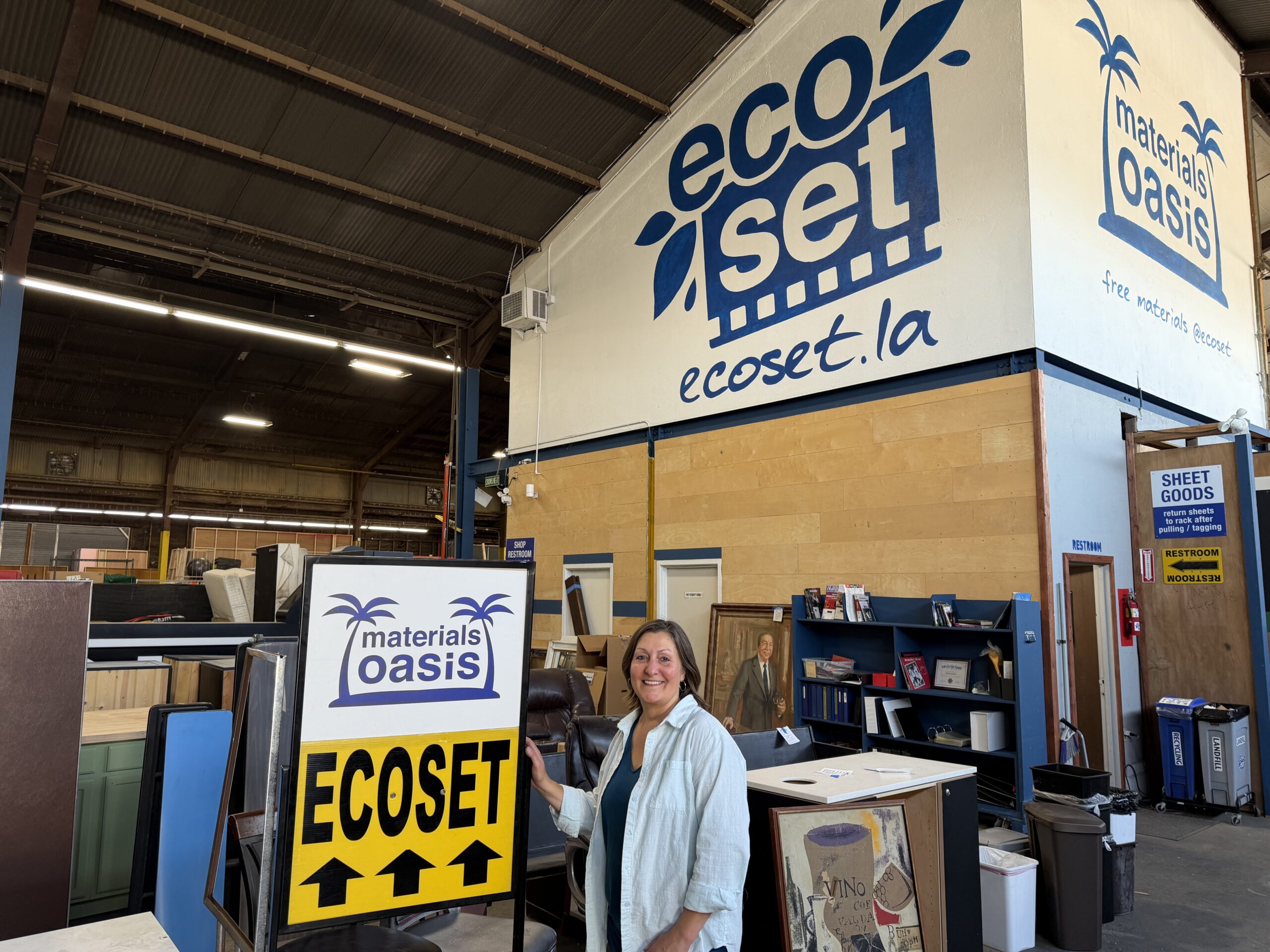
Kris: Hello I’m Kris Barber with EcoSet and we’re based in Los Angeles. We are a certified women-owned business, and we provide sustainability solutions for the entertainment industry. And that includes film and television productions, advertising, commercial marketing productions, and events. So we have our hands full trying to make a traditionally wasteful process more sustainable, more conscious. We were founded in Minnesota in 2008 by a woman named Shannon Bart. She and I had met in the 2000’s working as freelancers on film productions. She had been very aware of the fact that a lot gets thrown away from film productions and she wanted to be part of a solution that could reallocate resources within communities and then also manage things such as recycling, composting, and food waste more responsibly. So she founded EcoSet after we had worked together on a feature film and then we brought the services to Los Angeles. We hit our 17 year mark and we’ve had a lot of trials and tribulations, a lot of rough times in the film industry-strikes and pandemics. But we’ve developed a very resilient business model, which is to continually pivot and adapt to different growing needs. And so we’re a hybrid type of company. We’re part small business service provider, but we also are part community resource. We operate a donation center right inside of our warehouse and then it’s open to the general public for schools, nonprofits, artists and filmmakers to take reusable materials that are left over and discarded in the film industry.
Jama: We absolutely love this idea, especially because you’re helping so many others in the creative fields to be able to put on great shows. We know that this could be a hardship with schools and other organizations. So really amazing work. Thank you so much. Can you tell us what makes your business approach different from others that may be doing something similar?
Kris: We are in a kind of a small field in sustainable production. Everybody who’s doing it in the world pretty much knows everybody else. But the difference between us and some other similar service providers is we have a heavy logistics part of our work. We operate two warehouses and we have a fleet of trucks and trailers. We can go pick up materials-take semi-loads of materials from different clients that want to purge a lot of their marketing assets or different things that they don’t want to go to a landfill. Another unique part of our work is our clients range from student to studio. So we have film students that come in and rent a set wall from us or get free props, and then we work with studios like HBO and Netflix to clear out a storage unit or work with them during the strike process if a pilot isn’t picked up or if a series is canceled- everything used for that show has to go somewhere. A lot of times in LA it is sent to the landfill. We work with studios and streamers that have sustainability priorities to make sure that all of their useful resources are put back into the community. Another unique part of our work is really the life giving side- the ability to intersect with nonprofits and schools and directly have teachers come through our warehouse and get school supplies that they were probably going to pay for out of pocket. There’s the expression, the rising tide lifts many boats, and we get to see that every single day in our work- we’re managing the problem of waste, but we’re also helping people with free resources and stretch their limited budgets. So that goes from families to classrooms to independent filmmakers to theaters, puppet makers. There are so many people that come and benefit from free materials and it’s just part of our job but we love it.
Jama: That’s amazing. So I’m just curious, do you have like one specific day where you pick up inventory or you do inventory? I’m just thinking of the manpower that’s required to do all of that.
Kris: No, we have six loading doors so things are coming in from each door. So for example, tomorrow we’re getting a bunch of signage from the Coachella and Stagecoach festival, and then right now we’re loading in a storage clear out from Netflix. And so it’s something different every day. And we’re also working on set for a Target commercial, and managing all the school supplies and things that are going to be coming off of that commercial. We’re all over town and we’re doing a lot of different things. One of the things we’re really gearing up for is next week (and long term) we’re going to host some contents from the Olympics and they’re looking to us as a possible solution provider for an enormous amount of signage and vinyls and different materials coming off of those games.
Jama: Wow, that’s a lot, a 24/7 job! Thank you for sharing. Thank you so much for taking the time today. We really appreciate it. And congratulations.
WomensNet Blog
Resource Center

Amber Grant Winners
Read winner interviews and see what advice they have to offer for other women entrepreneurs.

How the Amber Grant Works
- Apply right now by telling us your story. No lengthy, complicated forms.
- Our Judges pick three $10,000 Amber Grant winners each month.
- Three of our 36 monthly winners will be awarded our $50,000 Amber Grant at the end of the year.
 Get application & business ideas on the WomensNet blog »